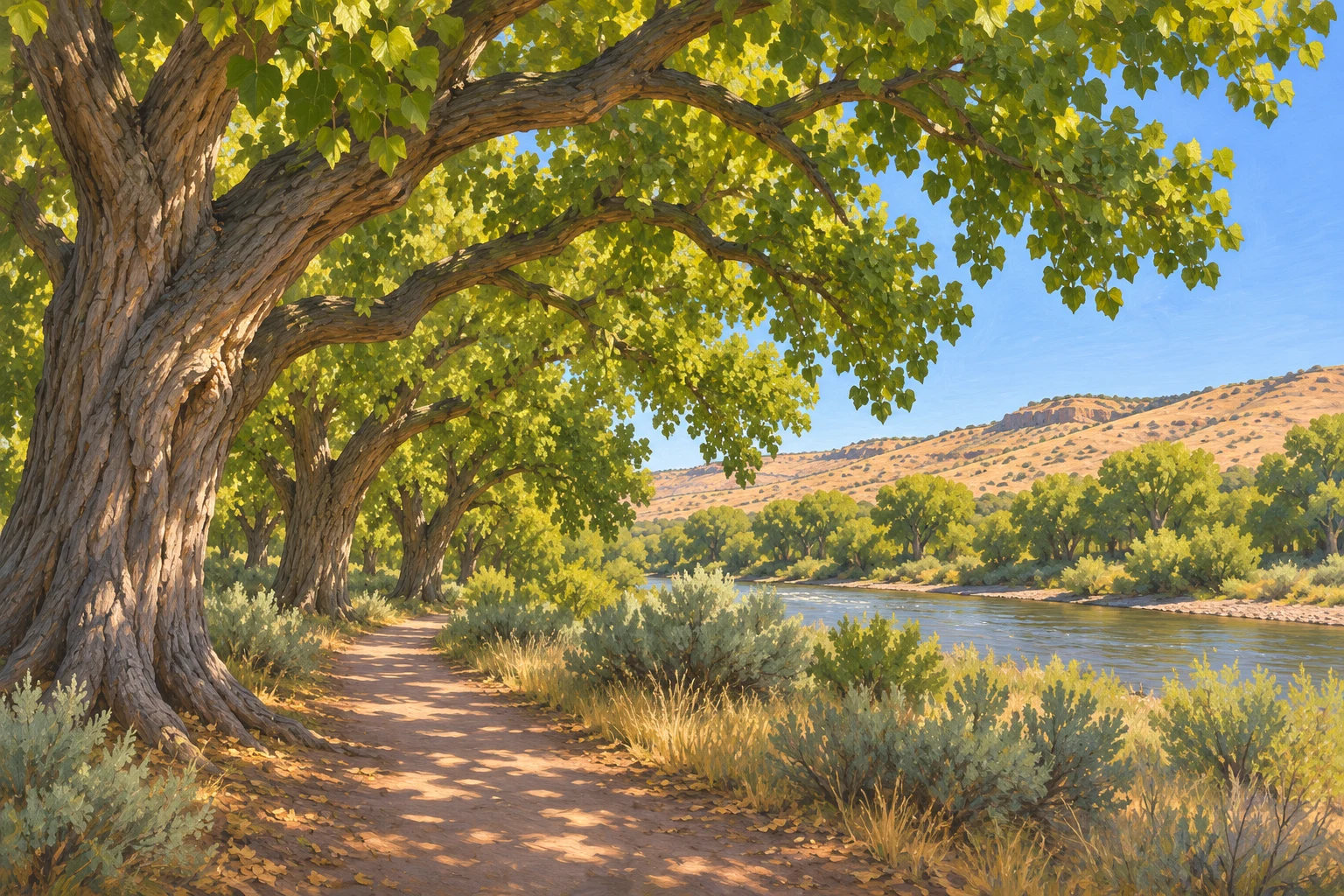
A walk beneath Albuquerque's cottonwoods can feel like entering a different landscape from the dry ground beyond the river corridor. Large trunks and a broad canopy make the forest easy to recognise. The harder question concerns its future: what allows another generation of trees to become established? A mature tree, a drifting seed and a young seedling represent different stages of that story.
The wooded corridor beside the Rio Grande is locally called the bosque. For a traveller from Botswana, it offers a specific way to explore an American city through water and vegetation rather than only through buildings. You can enjoy an ordinary authorised walk while learning why the presence of large trees does not, by itself, explain how the forest renews itself.
Follow a seed beyond its drifting white tuft
Albuquerque's BioPark describes cottonwood seeds carried by downy white tufts and dispersed by wind or water. That helps explain the familiar association between the tree's name and its light, cotton-like material. The movement is only the beginning of the seed's journey. Reaching another place and becoming an established tree are different achievements.
Think about the change in scale. The canopy occupies a large part of the view, while an individual seed can disappear into the background almost immediately. A visitor might notice a conspicuous drift without seeing where the seeds finally settle. The visual impression can be striking even when it tells you little about the result.
Treat any seasonal sight as an observation tied to your actual visit. A date on an itinerary cannot reserve a display of drifting seeds. If the subject interests you, ask a local interpreter what stage of the tree's cycle is being discussed. A quiet canopy can still be worth understanding when the most conspicuous moment has passed or has not yet occurred.
Look for the conditions that make a seedbed
The BioPark's explanation identifies bare, moist soil and sunlight as important conditions for cottonwood germination. These requirements connect the tree's renewal with the river's changing margins. A seed arriving in the landscape needs more than an available patch of space; the condition of that ground matters.
This gives the edge of a path a different interest. From an established public route, consider the differences between shaded ground beneath mature trees, open sediment and a bank shaped by moving water. You are comparing visible settings, rather than deciding that every bare patch is a successful seedbed. The soil may look suitable in a photograph while other parts of the process remain unknown.
Keep the observation separate from an intervention. Leave seeds, seedlings and ground surfaces in place. An ecological explanation does not make a visitor responsible for planting the next tree or rearranging a riverbank. The useful discovery is that a forest's future can depend on small areas and particular conditions that are easy to overlook while admiring the canopy.
Connect the roots with water beneath the surface
The city's account also explains the importance of water within reach of cottonwood roots. A river corridor can therefore carry a story that extends below what a walker sees. The visible channel is one part of the setting; moisture in the ground is another part of the tree's relationship with water.
Try separating two questions during the walk. Where is water visible today, and what would you need to know about conditions below the surface? The first may be answerable by looking from a permitted route. The second requires information beyond a passing view. Keeping the questions distinct makes the landscape more interesting without asking a visitor to diagnose a particular tree.
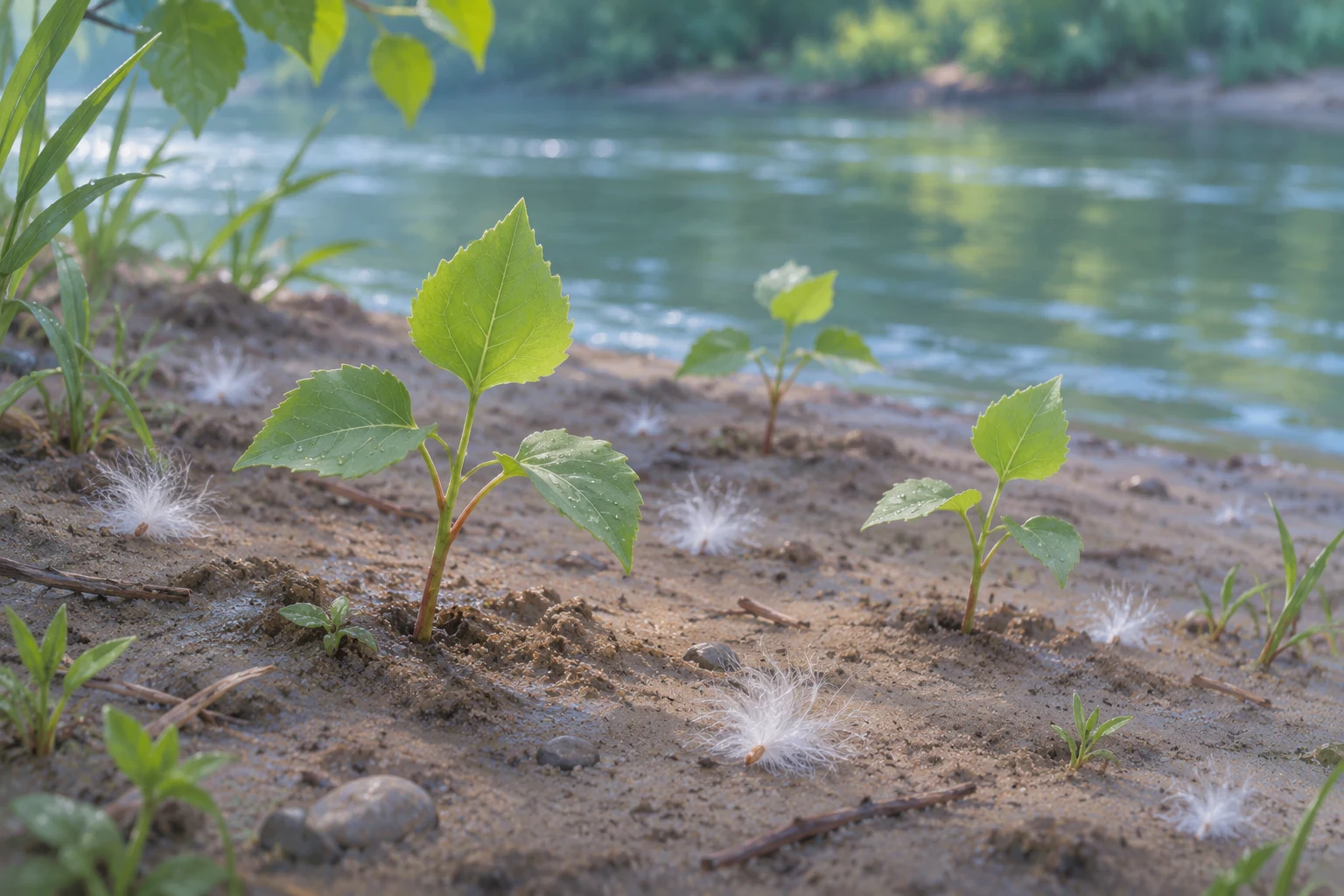
An adult tree can help hold your attention while you consider those limits. Its height and branches are immediate features of the scene, yet its continued presence does not supply a complete account of present groundwater or the survival of younger plants. A woodland can contain several histories at once. The conditions in which an older tree became established need not describe every opportunity available now.
Let repeated measurements widen the view
The Bosque Ecosystem Monitoring Program, or BEMP, researches the effects of flooding, fire, climate and human alteration in the bosque, with the University of New Mexico's biology department as its lead science partner. Its science account connects monitoring with questions about the results of management actions and restoration. That is a longer inquiry than a visitor can conduct during a pause on a trail.
BEMP's public data page distinguishes several kinds of records, including depth to groundwater, litterfall and precipitation. The listed datasets have their own time spans and update dates. A groundwater series labelled 1997–2017, for example, is a historical record to interpret in its stated period, rather than a live reading of the riverbank on your travel day.
Those distinctions are useful even if you never download a spreadsheet. Rain, material falling from trees and the depth of water in the ground describe different parts of the same environment. Keeping them separate helps explain why a forest cannot be assessed through one attractive scene or a single kind of measurement. You can appreciate the patience of the work without claiming that your own holiday notes form an equivalent dataset.
Make the river corridor part of an actual city day
The City of Albuquerque describes Rio Grande Valley State Park as a corridor with several access areas and both paved and natural-surface routes. It also identifies places with different purposes, including wetlands managed as habitat. A general map of the bosque should therefore be read alongside the current information for the particular place you intend to visit.
Choose a manageable encounter and confirm its arrangements before setting off. You might want a short woodland walk, a river view or a visitor-centre explanation, rather than a long journey across the entire city. Ask about the actual surfaces, access needs and restrictions that affect your party. If a protected area is closed to visitors, use an authorised overlook or another confirmed option instead of treating the forest as uniformly open ground.
The same care applies to a wider cycling plan. A paved city route and a small natural-surface path may provide different experiences. Use current local information to decide where your chosen activity belongs, then leave time to stop appropriately and look. A bicycle can bring you to a landscape without requiring every moment of the encounter to remain in motion.
Carry one question from the walk: what connects the drifting seed with a future canopy? Moist ground, available light, continuing access to water and the work of monitoring each add part of an answer. Albuquerque's cottonwoods can then become more than a shady interruption to a city itinerary. They introduce a living river corridor whose next generation asks for closer attention than the largest trunks alone can provide.
Be the first to share a thought or travel tip.