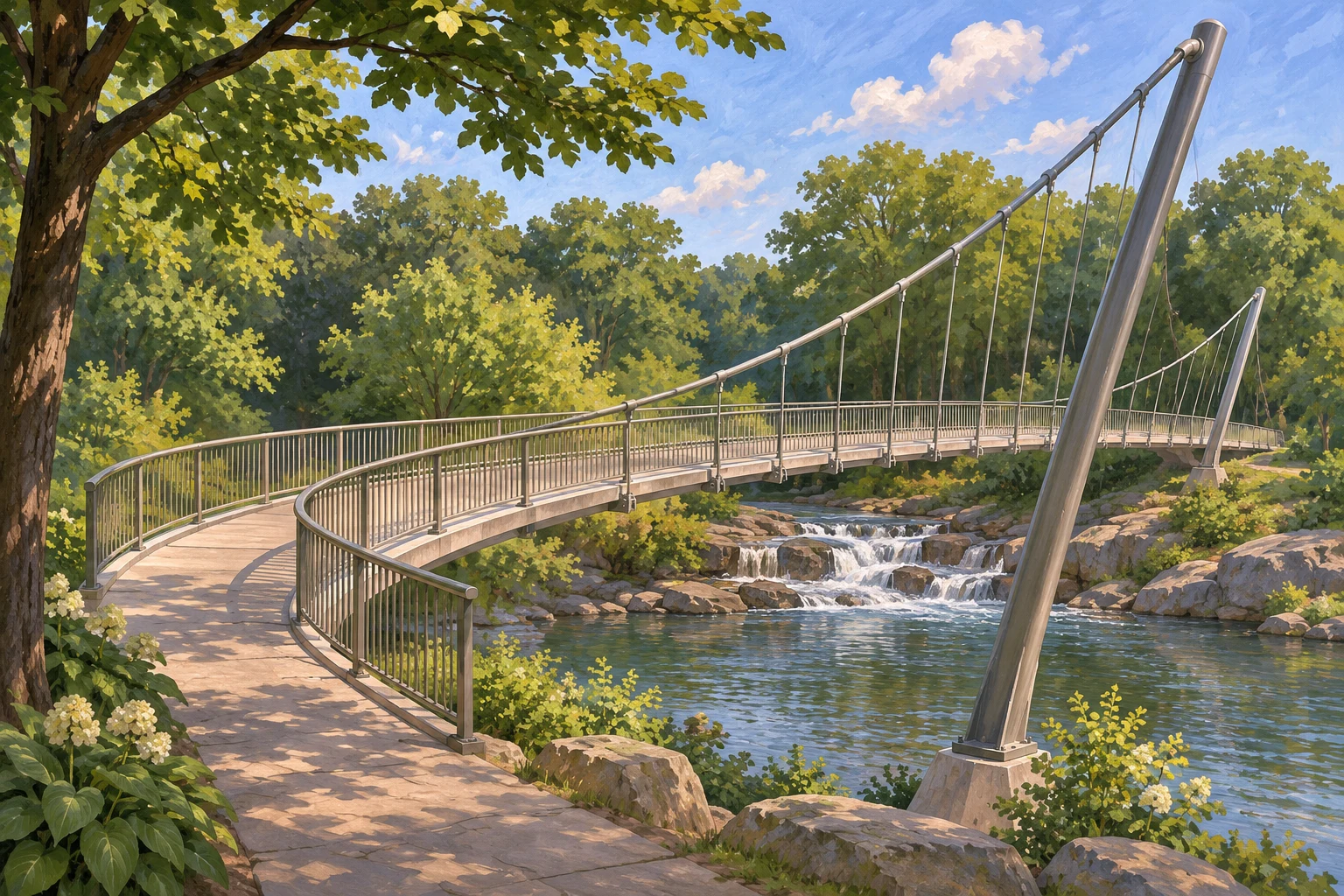
A bridge can do more than shorten the journey between two banks. It can decide where a person pauses, what remains visible and how a river belongs to a city. Liberty Bridge in Greenville, South Carolina, is interesting for that reason. Its curved pedestrian deck sits beside the Reedy River Falls, turning an ordinary crossing into a place from which to look back at water and landscape.
For a traveller from Botswana, this is a manageable way to explore an unfamiliar city's design. You do not need to recognise an entire architectural movement or memorise a list of dimensions. Begin with a simple question: why does this bridge take the shape it does? Following the relationship between its curve, supports and view can make a short park visit more rewarding than collecting another landmark photograph.
Read the curve as a choice about looking
Architect Miguel Rosales's project account explains that the bridge arcs away from the falls. The curve provides an elevated viewing position rather than following the shortest possible straight line across the river. It also places the new pedestrian structure within a park landscape where an earlier highway bridge had been removed.
That is a useful distinction to carry into the visit. The river is not only an obstacle to cross; it is part of what the crossing allows people to see. Consider the difference between moving towards a destination and finding a position from which to look. A slightly changing direction can make the experience of a bridge different from a corridor with water underneath it.
When the relevant public routes are open, look from more than one permitted position. A view along the deck emphasises its sweep, while a view from an established park path can place the structure beside the river and vegetation. Neither needs to be the definitive photograph. Together they can explain why the bridge is both a route through the park and a subject within it.
Notice which edge carries the suspension
The engineering firm schlaich bergermann partner describes the main suspension cable along the deck's outer edge, supported by two inclined steel masts. The arrangement leaves the inner side without the same visible suspension structure, helping keep the view towards the falls open. This asymmetry is central to the bridge's appearance; the two edges do not perform identical visual roles.
Start by tracing the visible lines with your eyes. Separate the curve of the walking surface from the curve of the main cable and from the smaller connections between them. They belong to one structure, but they are not one continuous line. Seeing that difference is more useful than attaching the word suspension to a bridge and deciding the explanation is complete.
Resist the urge to turn observation into an inspection. A public walkway is enough for this exercise. You do not need to reach over a barrier, approach a connection from outside an authorised path or find a way beneath the deck. The aim is to understand how the visible arrangement shapes the experience of crossing, while leaving maintenance and structural assessment to the people responsible for the bridge.
Give the less visible structure its share of attention
The engineer's account also describes the work below the deck: a steel truss contributes stiffness, and pre-stressed ring cables help balance the twisting effect of support on one side. The impression of a light, almost floating walkway therefore depends on elements that may not dominate a visitor's first view. A clear outlook does not mean the supporting work has disappeared.
This makes the bridge a useful example of the difference between an appearance and the system producing it. What seems visually simple can require several parts to work together. Once you know that, a photograph of the main cable tells only part of the story. The walking surface and the structure below it also matter, even when your chosen viewpoint gives them less emphasis.
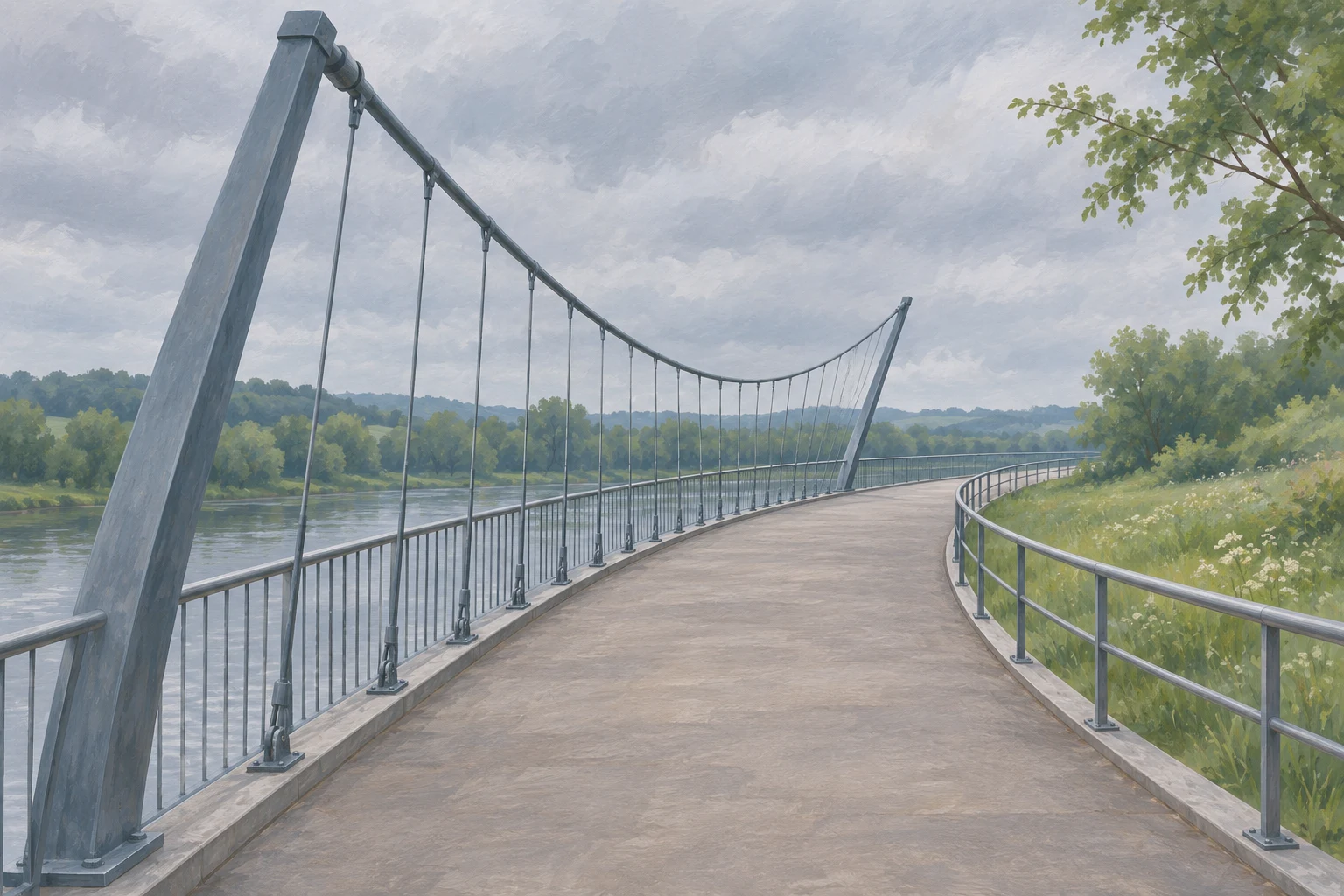
For a family, keep the explanation modest. One person can follow the path people walk; another can point out the supports that are visible from a normal public position. Compare what each noticed. You need not invent a load calculation or claim that you have proved how the bridge behaves. Learning that an uncluttered view can be the result of careful structural work is already a worthwhile discovery.
Keep the waterfall and the city in the same picture
The bridge does not need to be detached from its surroundings to be appreciated. Greenville's destination organisation describes Falls Park as a downtown landscape of walking paths, gardens and the Reedy River Falls. The bridge is one part of that setting. Its interest comes partly from the relationship between the constructed crossing, the water and the city around them.
Try making one observation about the whole scene before concentrating on an engineering detail. Where does the river draw your attention? How does the bridge's curve affect the way the opposite bank enters the view? These are questions you can answer from the scene in front of you without pretending that a single visit explains the park's entire development.
Give the outing a pace that allows those questions to arise. You could combine a confirmed park visit with a meal or another downtown stop, but the bridge need not become a rushed connection between reservations. For a traveller whose longer journey began in Botswana, an unhurried local encounter can provide a welcome change from airports and long transfers. Its value lies in attention, rather than the number of attractions reached afterwards.
Plan a walk around today's arrangements
A description of a bridge's design does not establish today's access. Before making a special journey, check the city's current park information and any notices affecting the bridge or approach paths. Ask about the route your group actually needs if stairs, gradients or resting places will affect the outing. A sweeping line in a photograph does not describe the entire journey from your arrival point.
Keep a wider cycling plan separate from this pedestrian encounter. A city can have an extensive trail network without every bridge, path or park section serving cyclists in the same way. Confirm the current rules for each part of your route rather than treating a general cycling recommendation as permission to ride wherever a path appears. Walking the bridge can remain the focus even when a different part of the day involves a bicycle.
Stay within established public areas and follow the current signs. The falls are part of the view, not a reason to improvise a closer approach over rocks or barriers. If an area is unavailable, use another permitted viewpoint or change the plan. The structure will still be interesting without attempting to reproduce a photograph made from somewhere your party cannot access.
Leave with one relationship you can describe clearly: the deck curves away from the water, the suspension is concentrated on one side, or supporting work below helps make the open view possible. Those observations give the landmark a more precise place in your memory. Liberty Bridge can be remembered as a designed way of encountering Greenville, with the crossing and the looking working together.
Be the first to share a thought or travel tip.