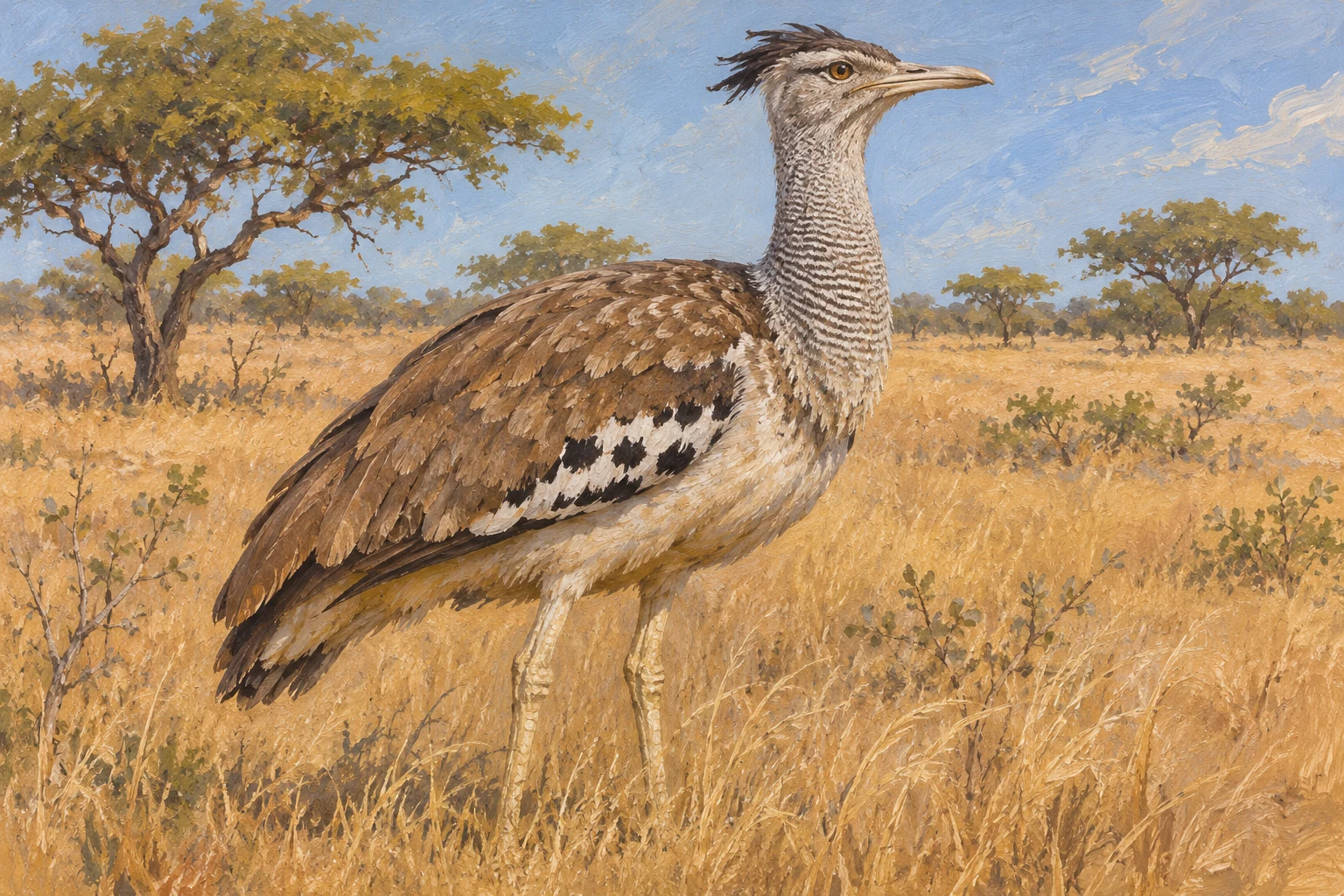
A large bird walking through open savanna can hold attention without taking flight. The kori bustard's heavy body, long neck and deliberate movement offer a different sort of Botswana wildlife encounter from a bird seen briefly overhead. Its interest grows when the question changes from how big it is to how it uses the ground around it.
The first Southern African Bird Atlas recorded kori bustards in Botswana, including places such as Deception Valley and Savuti. Those historical records establish a longstanding connection with the country's landscapes, rather than a promise of where an individual will be visible today. Learn the bird as a possible encounter and let the actual journey supply the observations.
Begin with a bird that can fly and often walks
BirdLife South Africa describes the kori bustard as a large terrestrial bird associated with dry, open savanna. Its size is striking, but the time spent on the ground is just as useful a starting point. The ability to fly and a life observed largely at walking height belong to the same animal.
If one is in view from a permitted route, allow the scene to develop before asking for another angle. Watch the sequence of steps and pauses. Does the neck remain upright, or does the head move towards the ground? These are ordinary observations, yet they describe the animal's activity more clearly than a photograph used only to demonstrate its scale.
Keep the difference between possible and observed behaviour. Knowing that a bird can fly does not mean a visitor needs to see it take off. A calm walking encounter is complete in its own terms. Asking a driver to approach until it moves would replace the behaviour you found with a reaction to your presence.
An unhurried pause can also bring the surroundings into focus. The space between plants, the available cover and the surface across which the bird moves become parts of the account. The animal is using a place, rather than standing in an interchangeable backdrop.
Read the arrangement of plumage and shape
BirdLife's identification account describes a dark crest, a finely barred grey-and-white neck, brown upperparts and a black-and-white pattern visible on the folded wing. A pale bill and long legs add to the overall appearance. The whole arrangement is more useful than selecting one isolated colour as proof of identity.
Follow the features the actual view allows. The head may be clear while grass obscures the legs, or a side view may reveal the wing pattern more readily than the crest. A bird in shadow can present a different first impression from one against bright, dry vegetation. Describe those limits to the guide rather than filling in details from a remembered picture.
A wider photograph can preserve the body's proportions and posture. A closer crop may be useful for a feature that was genuinely visible. Choose according to the question that interested you, and keep the two purposes distinct. There is no requirement for every encounter to become a perfect identification portrait.
Avoid assigning sex or age from size alone in a brief, distant view. The species includes differences between individuals, and your own sense of scale depends on the setting. It is reasonable to recognise a likely kori bustard while leaving finer identification to someone with a better view and appropriate knowledge.
Watch a varied search for food
Both BirdLife South Africa and the Smithsonian's National Zoo describe an omnivorous diet, including invertebrates, small vertebrates and plant material. The Smithsonian notes the importance of insects, particularly for chicks. A kori bustard's large body therefore belongs to an animal that can be interested in relatively small things on the ground.
That contrast is worth watching. A slight change in the direction of the bill may be the most revealing moment in an otherwise broad scene. Notice the action you can actually see, keeping a search, a peck and a clearly observed capture separate. An explanation of the usual diet does not identify an obscured item automatically.
This can make a familiar patch of savanna feel less empty. The size of a possible food item and the size of the bird searching for it are different scales of the same encounter. You can follow the relationship without knowing the identity of every insect or plant in the frame.
Leave feeding to the animal. Offering food would change the encounter and prevent the scene from answering the original question about how the bird uses its surroundings. A useful wildlife memory can consist of several modest movements that you noticed carefully, rather than a dramatic interaction arranged for the camera.
Understand a display without expecting a performance
The Smithsonian describes the male's courtship display as involving an enlarged throat region, raised tail feathers, lowered wings and sometimes a low booming sound. It explains that the oesophagus is inflated during this display. A change in outline is therefore part of a particular behaviour, rather than simply a permanently thick neck.
That background can help an unfamiliar posture make sense when an experienced guide identifies it. It should not become a demand that every bird display during a visit. The quiet individual walking ahead of you is doing something different, and its value does not depend on changing into the more spectacular pose seen in an illustration or film.
Pay attention to the context supplied by the guide. Which feature supports the interpretation? What was actually heard or seen? A broad description can introduce the behaviour while leaving the details of an individual encounter open. This keeps the explanation connected with evidence rather than turning an unusual outline into an invented story.
Accept the end of the observation when the responsible guide or host decides it is time to move. A display is a reason for particular care around the animal, not a reason to crowd it or remain in an unsuitable position. The interesting knowledge can stay with you even when the behaviour itself remains unseen.
Keep the ground available for the next generation
The Smithsonian's breeding account describes eggs laid in a shallow ground scrape, with the female responsible for incubation and care of the young. The chicks can follow her after hatching. This is a different family arrangement from assuming that any nearby male is helping rear the young.
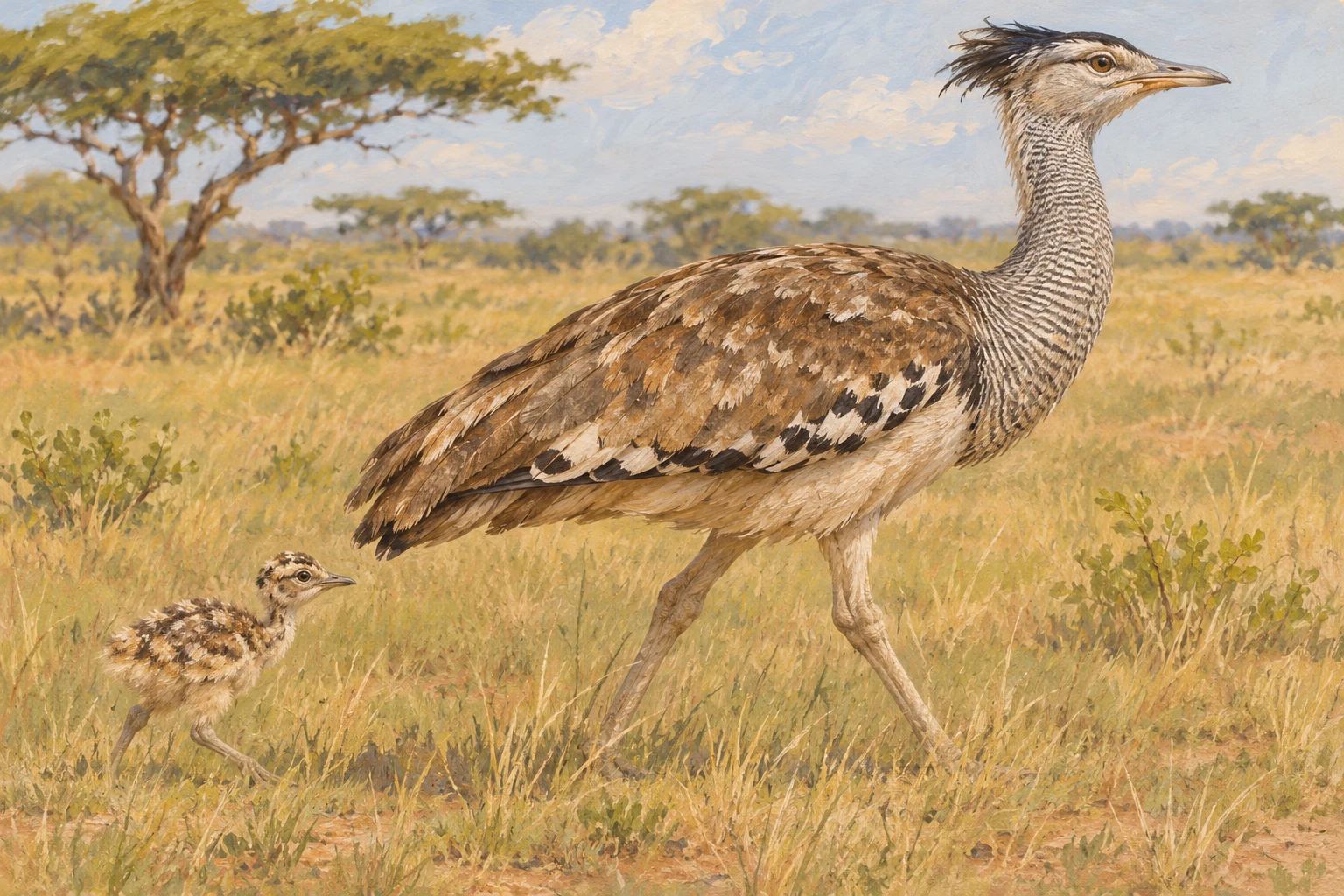
Learning about ground nesting should change the care taken with habitat, rather than add a nest search to the itinerary. Stay within the arrangements for the place you are visiting and follow the guide's directions. An apparently open patch can have a role that is not visible from a vehicle or path. There is no need to find eggs to appreciate the importance of leaving the ground undisturbed.
The 1997 atlas is historical. BirdLife's 2025 assessment covers South Africa, Lesotho and Eswatini. For your Botswana diary, record the place, date and behaviour observed; one encounter is not a census.
A kori bustard can begin as an impressive silhouette and become a much fuller animal through walking, searching, changing posture and caring for young. Giving those different parts of its life room in a Botswana journey brings attention back to the ground, where a large bird can reveal a great deal without ever opening its wings.
Be the first to share a thought or travel tip.