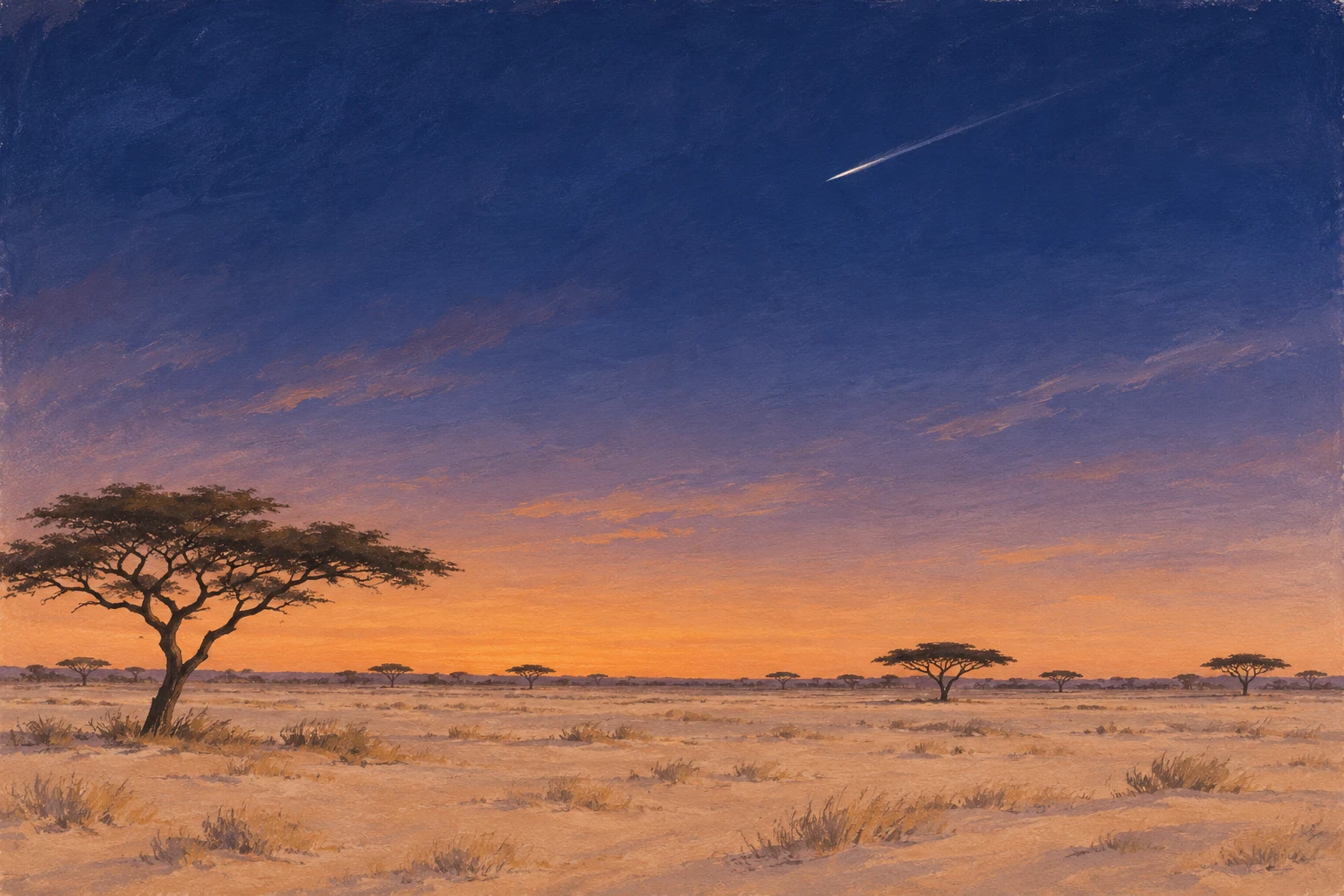
Botswana's Kalahari can invite attention in two directions: across the ground and up into the sky. The story of asteroid 2018 LA connects them unusually closely. Observations made before its arrival, recordings of a fireball over southern Africa and recovered stones from the Central Kalahari Game Reserve became parts of the same scientific investigation. The meteorite material is known as Motopi Pan.
For a traveller interested in Botswana's landscapes, this offers a different kind of encounter with the country. It is a story to understand through astronomy and geology, rather than a location to add casually to a driving route. Its fascination lies in the connections between different kinds of evidence, including the work of Botswana's research and heritage institutions.
Begin with the object seen before arrival
NASA's contemporary account describes the discovery of 2018 LA by the Catalina Sky Survey in Arizona on 2 June 2018, hours before its atmospheric entry over Botswana. Observations were passed to the Minor Planet Center and NASA's Center for Near-Earth Object Studies. Further observations helped narrow the initially uncertain prediction. The event was therefore studied as a moving object before the bright atmospheric display occurred.
That changes the way to approach the story. A spectacular light in the sky is usually the point at which a casual observer begins paying attention. Here, it sits within a longer sequence. The record made beforehand provides another way to ask where the object was going, rather than relying only on a memory of the moment it became conspicuous.
Keep discovery and prediction distinct. Finding an object does not automatically settle its complete path. The need for further observations is part of the interest, because each additional measurement can change what researchers are able to establish. A travel conversation can follow that progression without turning into a claim that every detail was known from the first image.
Let several viewpoints locate one event
The European Space Agency's retrospective account explains that later astronomical measurements refined the trajectory further. It also records visual reports from Botswana and South Africa and an infrasound detection associated with the event. Different observations concerned the same arrival, but supplied different kinds of information about it.
The Astronomical Society of Southern Africa's April 2021 account describes the use of video recordings to determine the location of the fireball's disruption. It identifies footage from Gaborone among the material used and explains that calibration contributed to locating the area in which fragments fell. A recording made at one place can therefore help investigate something occurring at a distance.
Consider what a camera records and what still has to be worked out. The image shows an apparent position within its own frame. Connecting that frame with other observations requires more than recognising a bright streak. This makes an everyday recording device part of a scientific story without making every dramatic phone video a complete measurement of an event.
A useful question for interpretation is what each viewpoint adds. One record can help with position, another with timing or brightness, and an earlier telescope observation with the approach. Their value comes from their relationship. There is no need to collapse the whole investigation into the single most impressive image.
Put Botswana's fieldwork into the account
The SETI Institute's 2021 report describes collaboration involving the Okavango Research Institute, Botswana International University of Science and Technology and Botswana Geoscience Institute. It identifies Lesedi Seitshiro of BIUST as the finder of the first recovered meteorite and records coordination with Botswana's museum and wildlife authorities. The search was organised fieldwork within a protected landscape.
ASSA's account places the initial search in June 2018 and a further search in October. It reports one fragment from the first effort and 22 more from the later one. Those are the results described for those historical searches, rather than a statement of how many samples exist today or what any visitor might find.
The distinction between locating a fall area and recovering a stone matters. An area indicated by observations still has to be examined on the ground. People, institutional cooperation and patient attention connect the predicted place with an actual recovered sample. The landscape is part of that work, rather than merely an empty backdrop to a discovery made elsewhere.
Do not turn a published search account into a self-guided collecting excursion. A scientific expedition's arrangements do not establish public access to its working area. The story can deepen an ordinary Botswana journey without changing the permissions, routes or activities agreed for that visit.
Allow the stone to ask a different question
The SETI account describes laboratory investigation of the recovered material, including mineral and chemical work that placed it in the howardite-eucrite-diogenite group, commonly abbreviated HED. Combining the rock evidence with the orbit supported a likely origin associated with Vesta. Its discussion of a particular source crater was a research interpretation, rather than a directly witnessed departure from that crater.
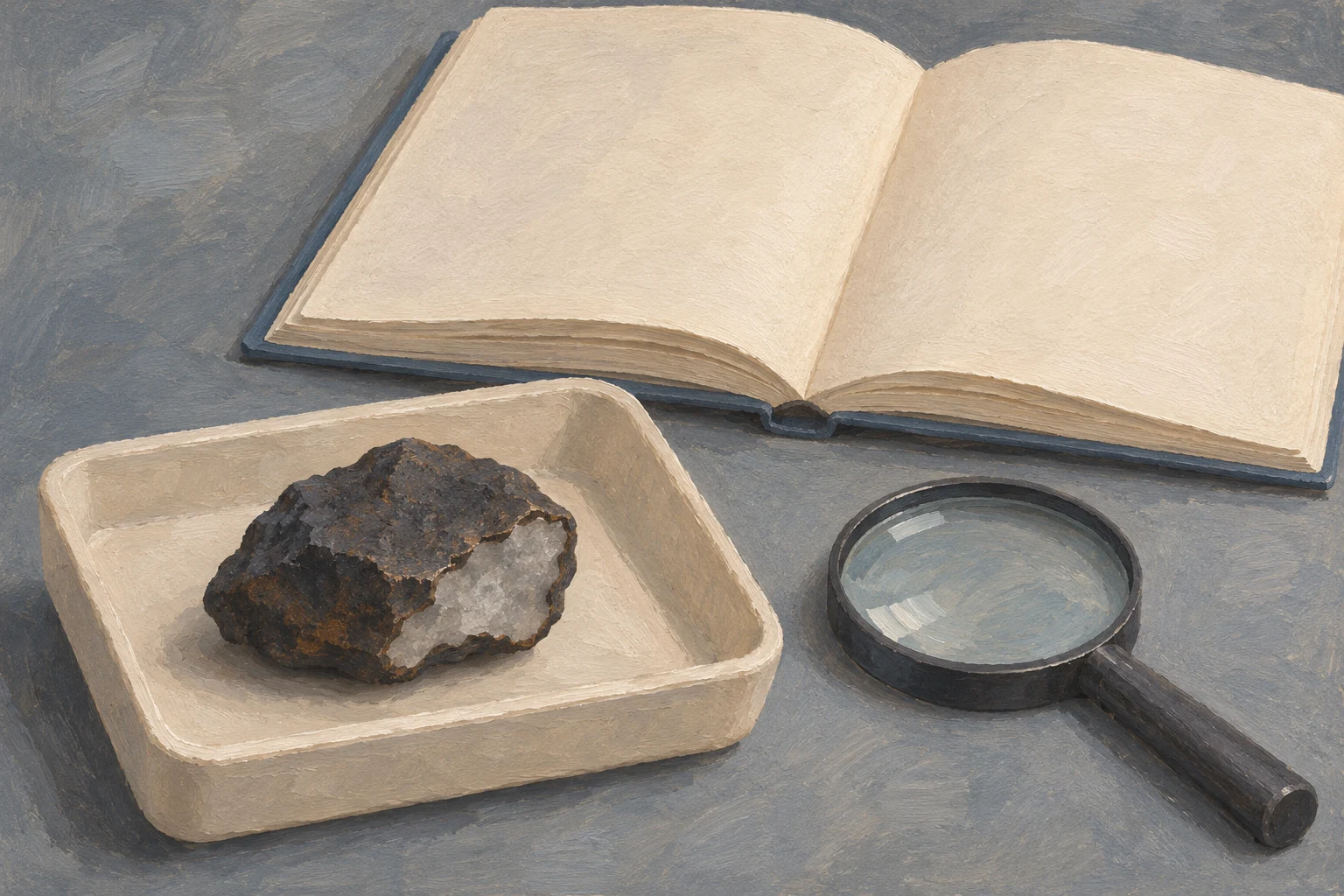
This introduces a useful change of scale. The field search asks where material reached the ground. Laboratory work asks what the material is and what it can reveal. A small stone can have a long account attached to it because its significance depends on measured properties and documented context, rather than on looking spectacular in a display case.
Read words such as likely and candidate carefully when they occur in scientific interpretation. They indicate how a conclusion is being expressed, not an invitation to replace it with a more dramatic certainty. There is plenty of wonder in a supported connection that remains open to further investigation.
Carry a chain of questions into your journey
If astronomy or geology interpretation forms part of your Botswana stay, ask whether Motopi Pan is discussed and how its different observations are explained. Check the actual programme or institution before travelling specifically for a presentation or specimen. A scientific report does not confirm a current exhibition, an accessible collection or a scheduled talk.
You can also explore the subject through published explanations during an unhurried evening at your accommodation. Sketch a simple sequence in a notebook: object observed in space, atmospheric event recorded, search area investigated, material recovered and properties studied. Add a question beside each stage. What was measured, who contributed and what did that stage make possible?
Keep the historical event separate from tonight's sky. Learning about 2018 LA does not promise another fireball during a visit or identify an unfamiliar light seen from camp. Follow the host's arrangements for any outdoor evening and enjoy what is actually present, without asking the landscape to repeat a remarkable past event.
Motopi Pan gives Botswana a place within a wider investigation that joins distant telescopes, local recordings, field teams and laboratory work. Remembering those connections offers more than a dramatic account of something falling from space. It reveals how a brief event can become lasting knowledge through several kinds of careful observation.
Be the first to share a thought or travel tip.