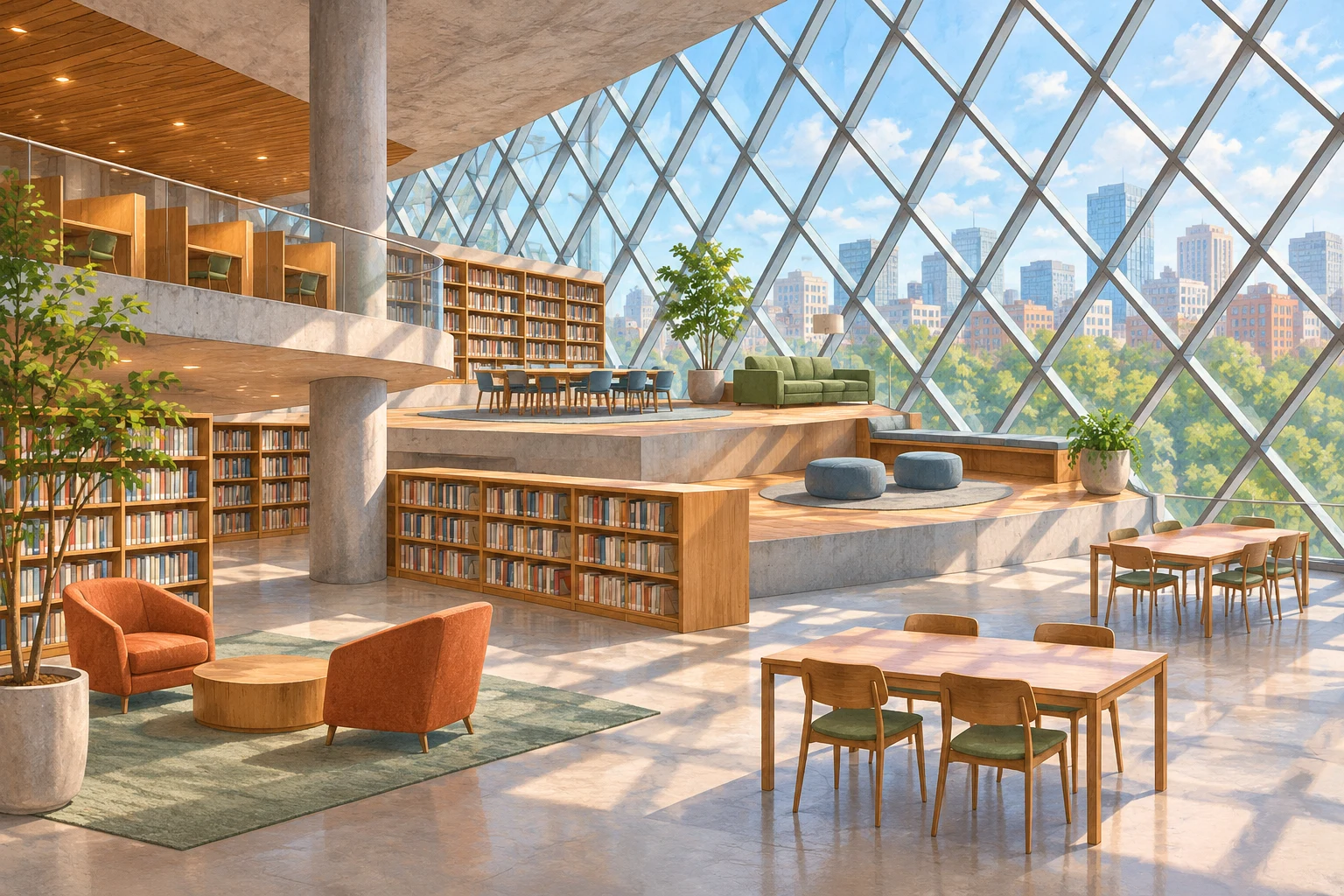
A library can be a destination because of what happens between its shelves. At Seattle's Central Library, the Books Spiral gives that idea a physical form: a nonfiction sequence continues through a gradual change of level. The building asks an interesting question of a city visit. What changes when a collection is arranged as a continuous journey rather than divided by the usual break between floors?
For a traveller from Botswana including Seattle in a wider United States stay, this is a specific reason to spend time in a civic building. You can look at the architecture while remembering that other people are there to read, work and ask for help. A rewarding visit follows the relationship between space and use, rather than treating the library as an empty backdrop.
Begin with activities rather than an unusual outline
The library identifies Rem Koolhaas and Seattle's LMN Architects as the design collaboration behind the building. Its architectural account explains the asymmetrical form through overlapping platforms and clusters accommodating different activities. The Books Spiral, meeting areas and more fluid public spaces have different roles within the whole.
This gives a visitor a useful alternative to deciding whether the exterior looks beautiful or strange. Start with the activity a space supports. A quiet table, a collection aisle and a place to seek assistance do not ask the same things of the people using them. The building becomes easier to read when those purposes are kept in view.
OMA's project description likewise connects the faceted form with a combination of platforms and intervening spaces. It presents the Books Spiral as an organising system for a physical collection that can grow. The striking shape belongs to an argument about how a library works, as well as to the city's skyline.
You need not agree with every design choice to find that argument interesting. Notice what helps you understand where you are and what requires a second look. Your own encounter can be modest and particular: one successful transition, one confusing junction or one place where the view makes the arrangement clearer.
Follow the collection without turning every floor into a restart
The library describes the Books Spiral as a continuous run from Levels 6 through 9. In its audio-tour transcript, it explains that the nonfiction collection follows the Dewey Decimal System, with classification numbers marked along the walkway. The sequence and the route through the building are therefore connected.
Choose a subject that interests you, then use the current catalogue and staff guidance to understand where it belongs. A call number does a different job from a floor number. One places a book within an organised collection; the other locates a level within a building. Seeing how they work together is part of the interest of this arrangement.
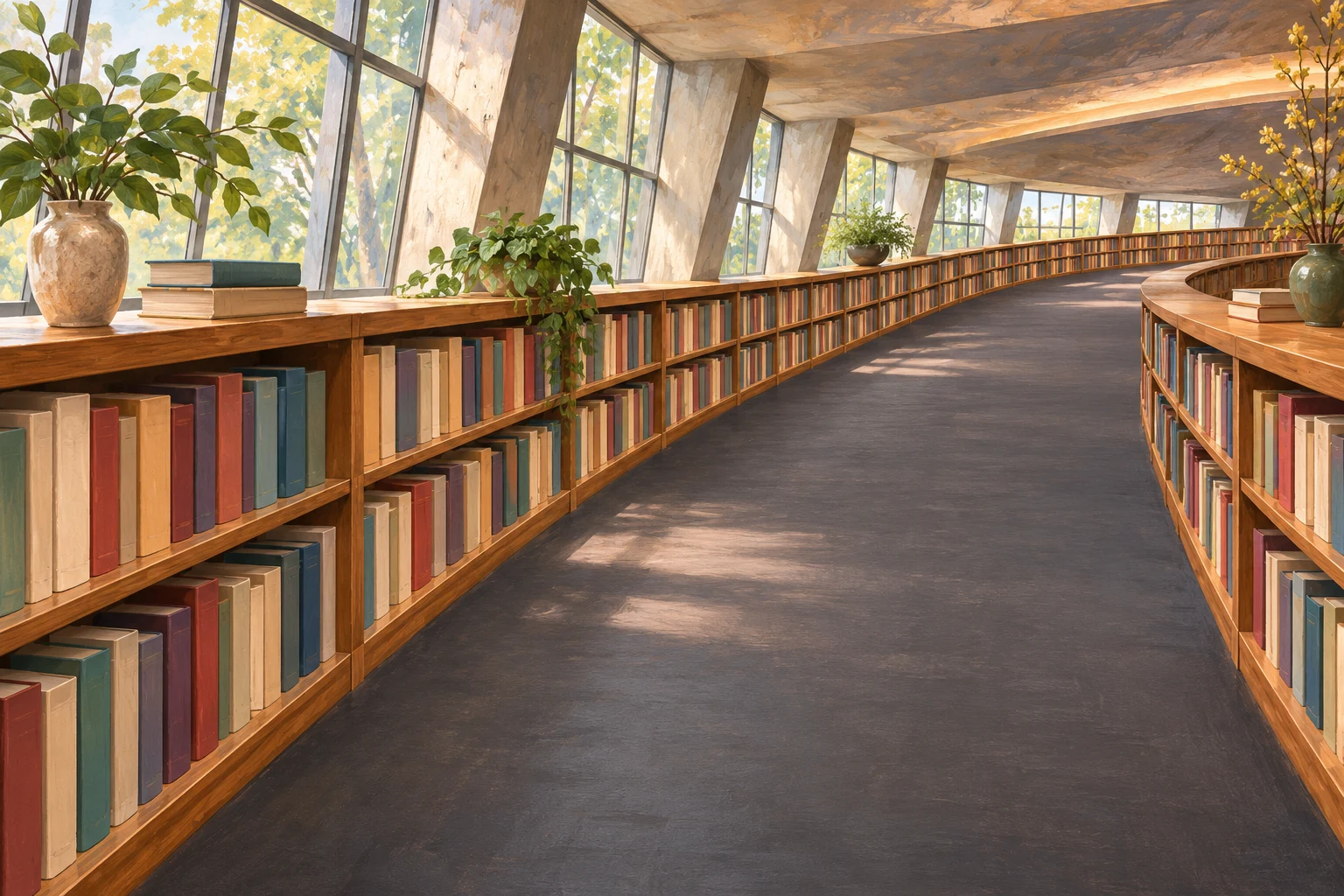
There is no need to walk the complete sequence to appreciate the idea. A short stretch can reveal how neighbouring subjects remain connected while the route changes height. Browse according to the library's arrangements, keep the aisle available to other users and ask before handling material whose access conditions are unclear.
Treat the word spiral carefully. The subject here is an extended shelving arrangement across levels, not a promise of a circular staircase or one dramatic central coil. Let the actual layout and the library's own orientation material establish what you are looking at.
Notice the work behind a seemingly simple slope
The audio-tour transcript reports that the design team made full-scale mock-ups before finalising the spiral and invited people of different ages and abilities to try the slope. That account adds a stage between an architectural idea and the finished collection space: testing how people would move through it.
This is worth remembering when a design appears effortless. A route is experienced through its length, changes of direction, nearby shelves and connections with other spaces. A photograph may communicate one of those features while revealing little about the rest. Looking at the building in use allows questions that an exterior image cannot answer.
Avoid turning the historical testing account into a guarantee for every visitor today. If particular mobility arrangements matter to your group, ask the library about the current route, lifts, assistance and any affected areas before setting out. An architectural description cannot settle an individual's needs on a particular day.
A family can make this part of the visit without treating it as an assignment. Compare the feeling of a collection aisle with another public space in the building. Someone may notice the shelves; another person may notice light or the ease of finding a destination. Different observations are useful precisely because people experience the same route differently.
Let other rooms explain what the spiral does not
The library's tour guide identifies a Living Room on Level 3 and the Mixing Chamber on Level 5. It places the Map Room and Writers' Room on Level 9, and a Reading Room and Seattle Room on Level 10. These names describe different purposes; they are not interchangeable extra viewpoints along a sightseeing circuit.
Choose one comparison that suits your interests. The difference between browsing a collection and settling at a reading table may be enough. Someone interested in local history might instead ask how to learn about the Seattle Room's resources. Specialist collections and workspaces have their own arrangements, which should be checked separately from general building access.
The audio-tour account describes sound-absorbing nylon pillows beneath the ceiling above the upper reading area. It is a reminder that a room's character can depend on details beyond its outline. Consider the view, materials and atmosphere together without attempting your own acoustic or engineering assessment.
A library visit works best when it leaves room for the library's ordinary life. Keep conversations considerate, avoid photographing other users without permission and follow staff directions. A room is not failing as a visitor attraction when people are quietly using it for the purpose for which it was made.
Leave with a clearer account of how the building is used
Before arriving, consult current Central Library information for opening arrangements, available areas and the kind of visit your group needs. The library provides self-guided material, but a published tour description does not confirm that every space or service will be available at your chosen time. Do not make an unconfirmed appointment or specialist room the essential centre of the day.
Keep the outing proportionate. You might follow a short section of the Books Spiral, compare two public spaces and then spend a little time reading. That is a complete encounter. Completing every floor is less useful if it leaves you unable to remember what made the arrangement distinctive.
A travel notebook can preserve the visit through three connections: where the subject sequence continues, where the activity changes and where you understood your position within the building. Describe what you actually encountered rather than copying the entire list of facilities into a personal account.
Seattle's Central Library can remain an impressive piece of architecture while becoming something more understandable. The shelves, gradual route, assistance spaces and reading rooms reveal a building organised around different ways of finding and using knowledge. Paying attention to those relationships gives the Books Spiral meaning beyond its unusual name.
Be the first to share a thought or travel tip.