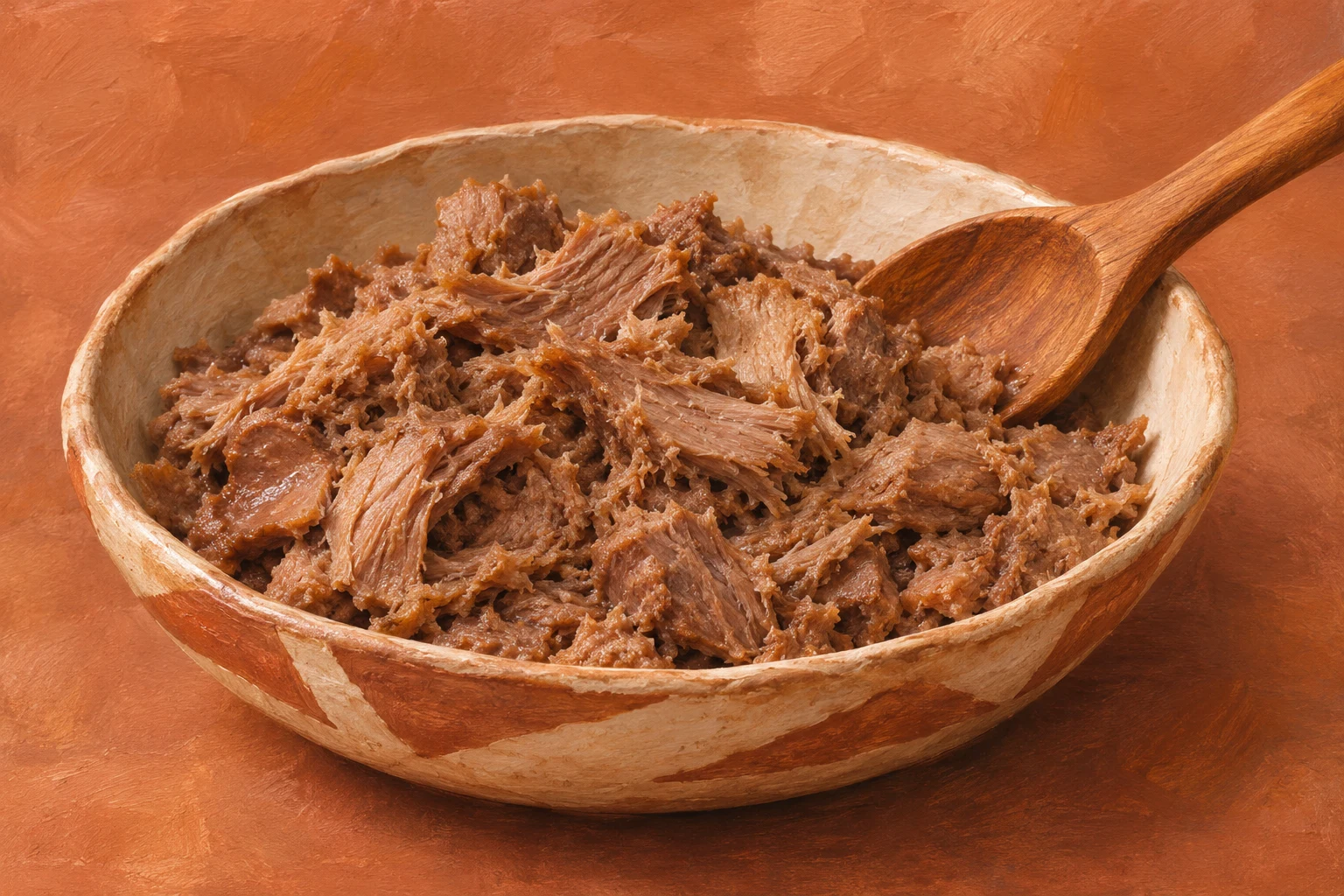
A serving of seswaa can look modest beside the other food on a plate. There may be no elaborate sauce or dramatic garnish to announce its importance. Its character lies in the meat's texture: cooking and pounding have changed a solid piece into something that can be shared in a different form. That transformation gives a visitor a useful starting point for understanding the dish.
For a Botswana food journey, seswaa is worth approaching through the meal actually offered. The meat used, its degree of moisture and the accompaniments all shape the encounter. Learning to notice those choices is more rewarding than expecting every plate to confirm one definitive national recipe. A familiar dish can carry both continuity and the decisions of the person preparing it.
Begin with what pounding changes
Botswana's government-published Kutlwano recipe archive describes seswaa sa podi made with goat meat. Its preparation separates cooking from pounding: the meat is first made tender, then bones are removed and the meat is pounded. That sequence explains why the finished texture matters. The dish is not simply a smaller cut of the meat with which the preparation began.
Look at an offered serving before taking the first mouthful. Can you distinguish loose fibres and small irregular pieces, rather than the uniform appearance you might expect from meat minced before cooking? The comparison is a way to direct attention, not a test that every cook must pass. Different preparations and serving conditions can produce different appearances.
Knowing the broad sequence can also improve a conversation with a cook. Instead of asking only what seasoning makes the dish distinctive, ask what texture they are aiming for. That question leaves room for the work of cooking and finishing to enter the account. It does not require requesting access to a working kitchen or a complete recipe during a busy meal service.
Notice the balance of moisture
The Kutlwano preparation returns some cooking liquid after pounding to achieve moisture without making the meat too wet. The useful distinction is between a texture that holds together pleasantly and an assumption that a large amount of liquid must be the defining feature. This is one published preparation, rather than a fixed measure for every serving of seswaa.
At the table, consider how the meat sits on the plate and how it meets an accompaniment. A small forkful can hold fibres together while leaving their structure visible. A wetter component beside it may change the next mouthful. Take those impressions as descriptions of the meal you are eating, rather than proof of how another household ought to cook.
The word simple can obscure this kind of judgement. A short ingredient list does not remove the decisions involved in achieving a finished texture. The point is not to rank cooks from a visitor's first taste, but to recognise that apparently straightforward food can still depend on experience. A dish need not contain many separate ingredients before its preparation deserves attention.
Ask which meat and which version you are meeting
Seswaa is often discussed through beef. Delly M. Chatibura's 2023 documentary review of Botswana's beef heritage examines it in that setting, including preparation skill and its role at gatherings. Reading one account closely does not require assuming that every meal uses the same meat.
Ask the kitchen what it has prepared and how it is being served. The name introduces the dish, but it does not supply a complete ingredient list or answer every question about a person's eating requirements. If a detail matters to your choice, have that conversation before ordering rather than infer it from the appearance of the cooked meat.
Chatibura also documents adaptations of seswaa into other formats, including small filled foods. That observation makes room for a changing cuisine without making an old report into a current menu. A contemporary serving can be interesting for what it retains of the pounded meat and what changes around it. Its format is a separate question from whether you understand the dish at its centre.
Give the accompaniments a part in the meal
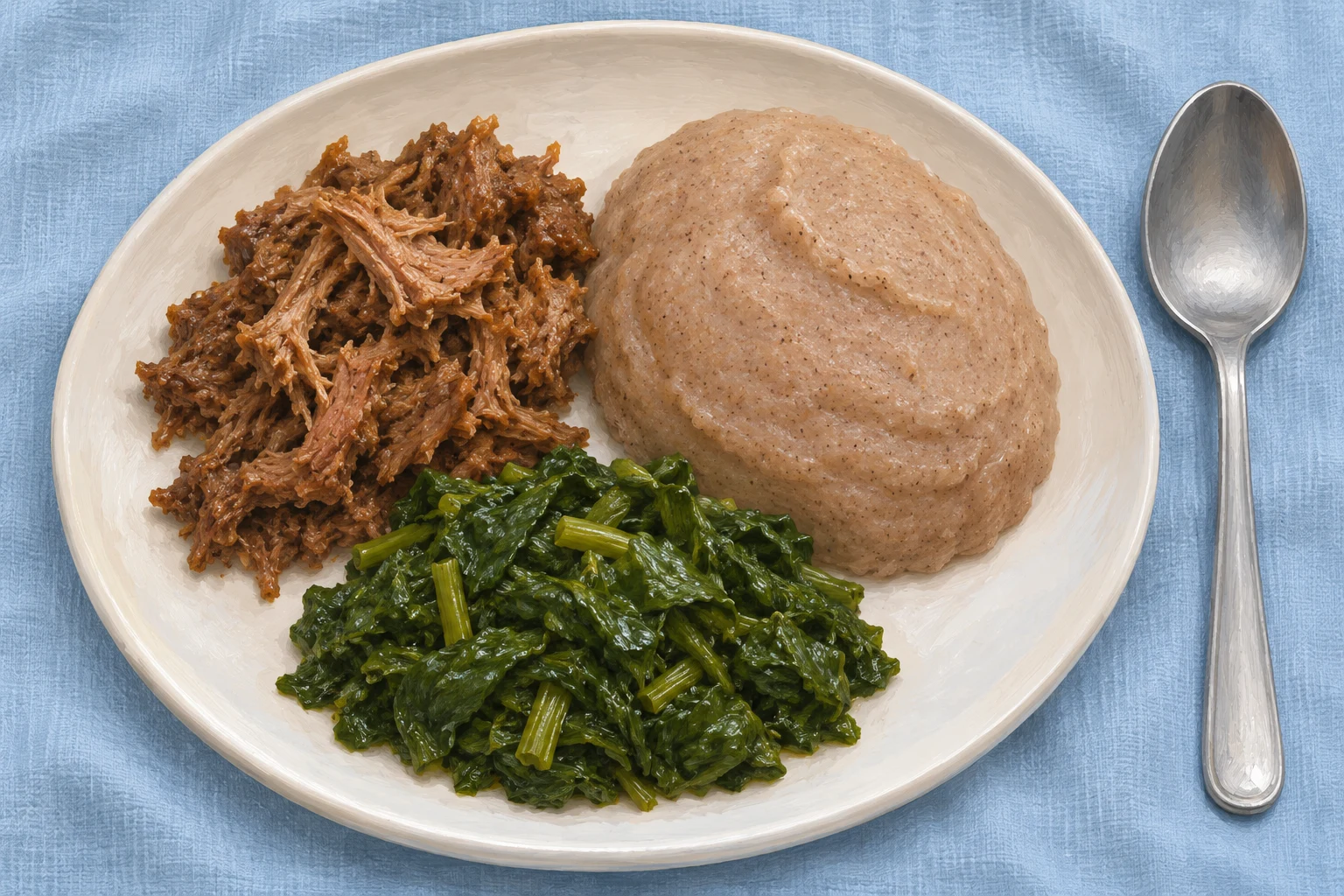
Kutlwano pairs its seswaa sa podi with bogobe jwa lerotse, bringing goat meat into a meal with a sorghum-based preparation involving cooking melon and sour milk. The pairing is more informative than a photograph of meat alone. It shows a particular published combination, while leaving other cooks free to prepare and serve a different meal.
Consider the components separately before mixing every mouthful in the same way. What does the meat contribute, and what changes when it is eaten with the accompaniment? A smoother component can make the texture of the fibres more noticeable by contrast. The whole plate may be satisfying for the relationship between its parts, rather than because one item overwhelms everything beside it.
This is also a practical way to order when several components are offered separately. Find out what the serving includes and choose a portion that suits the meal you want. A menu photograph may show an arrangement that differs from the day's service. You can remain curious about the food while making an ordinary, clear enquiry about what will arrive on your plate.
Follow living food beyond a ceremonial image
A January 2025 BOPA interview offers a specific example of traditional food entering a small business. It described Phatsimo Lepape and Mothusi Alfred's Kwa Seolong in Mogoditshane, with seswaa among a wider range of dishes. Lepape traced his business idea to watching his grandmother prepare food for an occasion. The account connects family experience with commercial cooking, rather than treating those worlds as unrelated.
The report belongs to its date. It introduces named people and a food enterprise without establishing today's opening arrangements, stock or menu. Its wider value is the reminder that a familiar dish can be prepared within changing working lives. Food heritage does not have to remain visible only through a large public celebration; it can also be part of the decisions behind an everyday lunch business.
For your own journey, choose an available meal and let the actual preparation lead the encounter. Ask a host for a useful lead, then confirm directly what the kitchen offers. If the cook has time to discuss a choice, listen without demanding that their account represent every Botswana household. A brief explanation of texture or accompaniment may be enough to change the way the meal is remembered.
Seswaa rewards that attention. The interest lies in the work that turns meat into a shareable form, the judgement about moisture and the relationship with the rest of the plate. Keep the cook and the particular meal in view, and a familiar name can become a much more precise memory of Botswana food.
Be the first to share a thought or travel tip.